


Facial Implants
Consultations offered at our three convenient locations in Encino, Glendale and Bakersfield
Well-defined, chiseled facial features convey youth, beauty, and strength. If your features are too subtle or out of balance, it can negatively affect your overall facial harmony. The most prominent problems of this nature are an inadequate chin or underdeveloped cheekbones. Thanks to modern advances in facial implants, plastic surgeons can now address these issues in a balanced, natural-looking way.
Cheek and chin implants made from synthetic, Alloplastic materials represent the next leap forward in facial plastic surgery. Using advanced computer imaging, Dr. Younai can design custom facial implants to improve your facial balance and give you an overall better facial contour. He will also take detailed measurements of your facial bones, soft tissues, and your bite to make sure your new implants fit properly.
Cheek implants are especially popular among women. Full, round cheeks are considered a sign of femininity and youth. The addition of cheek implants can help you achieve this youthful contour. It can also reverse some signs of aging, as the skin is drawn smooth over the added volume of the implants.
Men more traditionally seek chin implants, which can help you achieve a strong, masculine jaw line. A weak chin is often undesirable in both sexes, but particularly in men. Chin implants are also great for achieving better facial balance if you have a prominent nose.
Although there are some differences in standards of beauty, cheek and chin implants can benefit men and women. There are many women who seek a more prominent chin, and plenty of men request cheek implants. The goal with any procedure using facial implants is to enhance your natural beauty and achieve a more proportional facial appearance.
Contents
The Procedure
At one time, plastic surgeons grafted the patient’s bone or cartilage to augment facial features, and correct weaknesses and defects caused by aging or genetics. In addition to Autologous implants which are derived from a person’s own tissue, synthetic or Alloplastic implants are now also used for facial augmentation. These Facial Implants are man-made synthetic substitutes, generally made of solid silicone, or porous materials such as Polyethylene, to surgically enhance the cheeks, chin, nose, jaw, and lips.
Cheek Implants provide greater definition and fullness to flat cheekbones to convey the healthy, youthful look that strong, high cheekbones express.
Men and women with flat, thin and round faces are good candidates for Cheek Implants, as are those whose faces have hollowed from weight loss, aging, or disease (Lipoatrophy). These Cheek Implants come in a variety of sizes and shapes in order to enhance the facial features of people with different ethnicities and heritage.
The facial cosmetic surgeon can augment the Malar region, the outer upper cheek area, or the Submalar region, the lower or mid-cheek area that becomes gaunt and sunken as we age.
For the augmentation of the malar or cheek region, your facial plastic surgeon will make one of two kinds of incisions – an Intra-oral Canine Incision or a Trans-conjunctival Incision in the lower eyelid.
The surgeon then creates an exact pocket between the cheekbones and their overlying soft tissues, and places the implants into that pocket. During Submalar implantation, the plastic surgeon positions an anatomically designed silicone implant over the mid-third of the face which fills in the hollow area below the cheeks. Sometimes, Cheek Implant surgery is performed in conjunction with a Facelift or Blepharoplasty/ eyelid tuck to replenish the lost facial volume.
Chin augmentation or Genioplasty uses Chin Implants to augment or enlarge a weak and receding chin, thereby improving the overall facial harmony. It is not just the size of chin that is important, but more so, it’s relative projection to that of the nose and lips from the side profile. Chin implants can either be inserted through a small incision from under the chin (submental) or through the mouth.
Nasal Implants for the augmentation or reconstruction of the nasal bridge are maybe the most commonly used types of implants. In fact, in Asia ivory, bone, or cartilage were used centuries ago to reconstruct an amputated nose or to enhance the size of the nasal bridge. Today’s Alloplastic nasal implants are made of high-density polyethylene and come in different shapes, sizes, and thickness. Men and women who are candidates for this surgery include those whose noses need added tip support, bridge contour or rebuild collapsed nasal bridge. Different Nasal Implants are designed to enhance different ethnic nasal features of different races including Asians, African Americans, Hispanics, and Caucasians.
Jaw Implants augment and strengthen a weak-appearing jaw, and are inserted into a pocket over the angle of the jaw by the cosmetic surgeon through an intra-oral incision.
Traditionally, Lip Augmentation was performed by the injection of collagen, fat, Alloderm or other fillers. Because these fillers are temporary new arrays of Ultra-soft and pliable synthetic lip implants have been developed such as Gortex or PTFE lip implants. These new lip implants can be formed to the desired shape and fullness, and inserted through small incisions at the corners of the lips.
Types Of Implants
There are a variety of options when it comes to implant types, including natural and artificial materials.
- Autologous Implants
- Alloplastic Implants
Autologous implants are derived from the patient’s own natural bone or cartilage, whereas alloplastic implants are made of synthetic materials like silicone or polyethylene. The materials used for your facial implant will depend on your specific goals, but all implants are biocompatible. This means that they are designed to function alongside living tissue.
Facial implants are most often inserted under general anesthesia. Dr. Younai then makes the incision(s) for placement of the implant. The location of the incision(s) will depend on the region you want to augment and the exact placement of the implant(s). For instance, chin implants can be placed through the inside of the mouth or beneath the chin. Jaw implants are typically inserted through incisions inside the mouth, as are some cheek implants. Depending on the area of the cheek being augmented, the incisions may also be made in the lower eyelids or along the hairline. Once the implant is properly placed and adjusted, Dr. Younai will close the incision with bioabsorbable sutures or stitches.
Before and After Photos


Lip Augmentation
One of the most sexy and youthful features of the face are the lips. Lushes, plump, and full lips are signs of youth, health, and fertility. As we age our lips lose their fullness and volume. The upper lip sags and becomes thinner. Meanwhile, fine wrinkles develop around lips which are called “lipstick lines” or “smoker’s lines”.
Lip augmentation consists of a variety of procedures designed to give a person a more defined and fuller lips. Besides enlarging the lips, lip fillers or implants are also used to balance the upper and lower lips.
Injection of fillers such as Collagen, Restylane, Perlane, Hylaform, Juvederm, Macrolane, Radiasse, Artefill, and fat into the lips is an easy way of enlarging or shaping the lips. Collagen is commercially available through plastic surgeons, but before having this procedure, you must first pass a collagen allergy test. Its advantages are, it does not require surgery and it is relatively inexpensive. Its disadvantage is that it is not permanent and usually lasts 3-5 months. Other newer injectable fillers such as those mentioned above usually last much longer than collagen and don’t need to be allergy tested. For Example Restylane lasts about 8 months, and Radiasse 24 months. Fat, tendon, or dermal grafting is another method used for lip augmentation. They require harvesting of the fat, dermis, or tendon from another area of the body. Its biggest disadvantage is that the lips remain swollen and inflamed for a much longer period than when synthetic fillers are used.
Unlike the temporary fillers, Gortex™ or PTFE is a synthetic non-dissolvable and permanent implant material that can be inserted at the periphery of the lips giving them more contrast as well as eliminating the lines that run into the lips (lipstick lines). In its newer multi-stranded form it is also used to augment the body of the lips. Patients find the feel of the Gortex implant very natural and acceptable. Alloderm™ is natural collagen matrix implant that is harvested from donors. It has the same consistency and feel of the skin. It can be shaped and formed to enhance and supplement the lip in a predictable fashion. It has a very natural feel and keeps its fullness for about one to two years. Both Alloderm™ and Gortex™ can be inserted into the lip under local anesthesia. After surgery lips become swollen and numb but this resolves over a period days to weeks. Compared to injectables, Gortex implant is permanent, but is more costly.
For those who are considering lip augmentation I suggest that they first have a more temporary treatment such as injectables before opting for a permanent solution. This way they can get a feel for what amount and type of lip augmentation would look the best on them.
These procedures like any other surgical procedure carry certain risks and have potential for complications. There is a risk of infection, which is minimized by taking antibiotics. Considering that no oness lips are perfectly symmetrical during normal pose or with smiling there are going to be minute asymmetries after surgery.
In general, I find people who opt for lip enhancement to be very happy with their surgery considering that they have realistic expectations.
Cheek Augmentation

Do you wish that you had higher, chiseled cheekbones? Has your face hollowed out after losing weight or with aging?
Cheek or Malar Augmentation with Implants can help balance and harmonize your facial features by giving you fuller cheeks, lift your face, and fill facial hollows.
Function
Prominent cheekbones are a hallmark of beauty in our culture. Men and women with strong, high cheekbones convey a healthy, youthful look. When your cheekbones are flat, this can cause a tired or aged appearance.
Often, patients who are focused on other features, such as their nose, eyes or sagging skin, discover that their greatest benefit would result from Cheek Implants. Cheek Implants provide greater definition to your cheekbones, to provide greater balance with the rest of your face.
Malar vs Submalar
The Malar Region is the outer upper cheek area that gives that chiseled appearance when the cheekbones are high. The Submalar region is the lower or mid-cheek area that becomes gaunt and sunken as we age. Your cosmetic surgeon can augment one, or both of these areas depending on your needs.
Candidates
Men and women with flat, thin and round faces can all benefit from Cheek Implants. For older patients, Cheek Implants fill out the cheek hollows and grooves that are associated with the loss of fat and soft tissues from aging.
Sometimes, patients who have lost weight also see a hollowing of their face, and prefer to have implants in lieu of gaining the weight back.
Men and women who are not good candidates include those with excessively thin skin, very prominent bone structure, significant facial asymmetry and a history of facial irradiation or severe immune deficiency.
Materials
Facial implants are either solid or porous. Usually, solid implants are made of silicone. Porous implants are usually made of polyethylene. The body responds differently to the two types. Solid implants become walled off by a “capsule,” that is a layer of tissue that forms around it. Porous implants on the other hand are fixed to the surrounding tissue by bone ingrowths.
One disadvantage of the solid implant is that it can move around once placed. Thus far, none of the complaints about autoimmune reactions that have been connected to silicone breast implants have been tied to silicone check implants.
Porous implants, on the other hand, remain in place, yet are more expensive and more difficult to place than are the silicone implants. They also usually require a larger incision because they are non-malleable and are harder to remove if misplaced.
Placement
In general, however, your cosmetic surgeon will make one of two kinds of incisions –, or one inside of the mouth on the upper lip — that is an intraoral “canine” type incision — or on the lower eyelid, that is a “Transconjunctival” approach.
The surgeon then creates a pocket between the cheekbones and its overlying soft tissues. The implants are then placed into that pocket.
The implants are sometimes sutured to anchor them in place, but most often your cosmetic surgeon will simply make a precise pocket that will hold the implant in its place until your body forms a capsule around the implant.
Submalar Implantation
Submalar augmentation is a technique that positions an anatomically designed silicone implant over the mid-third of the face. It gives the appearance of restoring the soft tissues hollows of the mid-face.
Size
Your cosmetic surgeon will have the implant designed according to a preoperative analysis of your facial size and structure. Your surgeon should involve you in the process, such as through photographing or depicting you in some way with the implant taped to your skin.
Combined Procedures
Yes. Sometimes, the cheek implants are inserted during Facelift or Eyelid Surgery when a patient with facial aging is deficient in facial volume and the tightening of the skin by a facelift will not adequately rejuvenate the face. Under such circumstances cheek implants are inserted through the incisions made for the facelift or blepharoplasty.
Chin Augmentation

Throughout history, a strong chin has been equated with beauty. When the chin is weak and receding, a large nose appears even larger, and the jaw and neckline appear out of place. In many men and women, chin projection is lost due to aging.
Chin Augmentation or Genioplasty with Chin Implants help to build out a recessive chin by inserting an implant over the chin bone. This improves the overall harmony of your facial features. Chin implants can also correct jaw asymmetry or irregularity for people with traumatic or genetic defects.
Materials
Generally, they are made of silicone, or another synthetic material. Those made of silicone are known as “Silastic” implants.
There are two types, solid, the type made of silicone, or porous – generally made of polyethylene. In some cases, the use of a bone graft – usually taken from the hip — may be advisable.
Risks
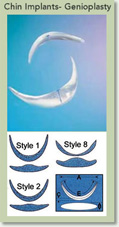
No implantation procedure is risk-free. However, silicone breast implants are made of a silicone gel, and have been implicated as the cause of autoimmune diseases. Unlike breast implants, silastic chin implants are made of a vulcanized solid silicone rubber, and have never been implicated as the cause of any disease. Smooth, solid silicone is an inert substance and has been used for implantation in numerous medical devices for decades.
Method
A pocket will be created in the chin, into which an implant will be placed.
Your cosmetic surgeon will make an incision, either inside the lower portion of your mouth, or under the chin. In incision inside the mouth will be made with removable stitches. Those below the chin will later need removal.
Once the incision is made, your surgeon will place an implant of the right size and shape for your face inside the pocket that was created. When the implant is inserted inside the mouth, there is no visible scar.
Anesthesia
As a rule, Chin Implant Surgery is performed under general anesthesia.
Combined Procedures
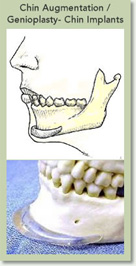
Sometimes, your cosmetic surgeon will perform Chin Implant Surgery with other procedures that improve your facial profile – such as Rhinoplasty (a “nose job”). It is also commonly performed with liposuction of the chin and neck.
Genioplasty
The terms Genioplasty and Mentoplasty are used interchangeably to refer to the reshaping of the jaw. (Many also include Chin Implant Surgery, i.e. Chin Augmentation under the rubric of “Genioplasty.”
In some men and women, the bones of their face and jaws are not proportional. In these cases, a cosmetic surgeon can correct the profile of the chin. Surgery to change the position of your chin is called Genioplasty. Often, this surgery is performed at the same time as corrective surgery on your jaw.
Genioplasty Method
Your cosmetic surgeon will make an incision through the gum on the inside of your lower lip to reach the lower jawbone and chin. Your chin will then be cut with a small saw, and broken. It will then be moved into a new position and held into place with small metal plates and screws. Your plastic surgeon will then stitch your gum back into place with dissolvable sutures.
Sliding Genioplasty?
This procedure is also known as “Chin Advancement.” It involves removal of a horseshoe-shaped piece of the chin bone, and then sliding it backwards or forwards. When it is in the desired position, it is fixed into place with titanium screws. Sometimes Bone Grafts are added.
Chin Augmentation vs Genioplasty?
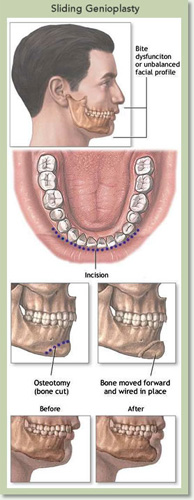
Genioplasty has a higher incidence of nerve damage than does Chin Augmentation through implants.
Genioplasty Anesthesia
As a rule, it is performed under general anesthesia.
Procedure Length
Generally, it requires between one to two hours.
Nasal Implants
Nasal implants are probably one of the oldest types of facial or even body implants that have ever been used. In Asia and Far East nasal implants shaped out of Ivory were used to augment flat noses. At times animal ribs were carved and fashioned for use in the reconstruction of traumatic nasal deformities.
Candidates
Nasal implants are generally used to augment the nasal dorsum or bridge. Many Asians and those of African descent don’t have prominent noses and at times are deficient in the height of the nasal bridge. In addition to wanting to enhance and balance their facial features, they often complain that their glasses slip off their nose because they don’t have a strong nasal bridge!
Esthetically speaking, lack of nasal dorsal or bridge height tends to make the nose look short and fat. It also makes the eyes appear too far apart. Finally, lack of forward nose projection also tends to make the face look too flat and round. Augmentation of the nasal bridge will help elongate the nose and gives the face a more refined and balanced appearance.
Materials
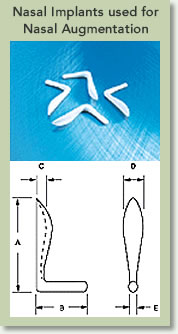
Most plastic surgeons prefer to used natural material for nasal augmentation, especially that from the patient themselves. This material is called an autologous graft, and is often harvested from the nasal septal cartilage, ear cartilage, ribs, or bone. While autologous grafts have the advantage of better acceptance by the patient’s body and less chance of infection; they do partially re-absorb or shrink. Besides requiring added surgery to harvest these grafts from a patient’s body, often the amount of tissue available for harvest might be limited and not enough to achieve the desired augmentation. On the other hand, synthetic grafts or implants are abundant and come in a variety of shapes and sizes. They don’t require added surgery to harvest a graft, and don’t re-absorb or shrink after implantation. Unlike autologous grafts, synthetic nasal implants carry a higher chance of infection or extrusion. These implants are typically made from Silicone, Gortex or PTFE.
Ethnicity
For many years, a “one size fits all” approach was taken to nose reshaping, and this also applied to the type of implants that were used. “Caucasian” implants were used on all patients.
Today, however, cosmetic surgeons tailor implants according to specific facial characteristics of various ethnic groups, including African-Americans, Hispanic, and Asian patients. For example, an implant used for an Asian is usually slimmer and smaller than one used for a typical African-American.
A skilled cosmetic surgeon will choose the appropriate implant size and shape and might even carve and modify them to customize it for the patient’s ethnic traits and specific facial features.
Augmentation with Nasal Implants
This is a procedure that should be performed only by a highly skilled plastic surgeon, with experience in ethnic nasal surgery or rhinoplasty. Generally, the surgery involves the creation of a nasal pocket for insertion of the specially designed implant. The incision is made inside the nose, with dissection along the dorsum or top of the nose to create the appropriate space for the implant. Rarely, sutures are used to hold these implants in place; instead a tight fit pocket will hold in the nasal implant in the appropriate place. After surgery, the implant is kept in the correct place by wearing a nasal splint for a week.
Adjunct Procedure
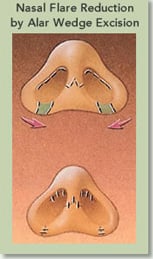
Besides augmenting the nasal dorsum, often times, the flare of the nasal ala or the nostrils are reduced. This is accomplished by making an incision in the nasal alar crease, removing excess ala, and reducing the size of the nostril opening.
Sometimes nasal “strut grafts” are used as a “post” to increase the height and projection of the nasal tip. Other times, grafts are used in the pre-maxilla, or the area between the nose and the upper lip, in order to reduce the appearance of a sunken mid-face.
Anesthesia
Nasal augmentation is an outpatient surgery that can be performed under sedation or with general anesthesia. The procedure takes about one hour, and usually the patient can be back at their usual activities within one to two days.
Risks
In general nasal augmentation is a very safe procedure. Typically, the nasal implant surgeries that carry a higher risk for complications are revision surgeries. It is not unusual to encounter people in such circumstance who have had a history of multiple nasal surgeries. In these instances the circulation to the nasal skin is sub-optimal, thus there is a higher chance for implant extrusion or displacement, infection, skin breakdown, and scarring. The best way of minimizing complications with nasal implant surgery is to have realistic expectations, use autologous grafts when feasible, and to seek a plastic surgeon who has had adequate experience in nasal implant surgery.